
That when a thing lies still, unlesse somewhat els stirre it, it will lye still for ever, is a truth that no man doubts of. But that when a thing is in motion, it will eternally be in motion...is not so easily assented to.
--Thomas Hobbes, Leviathan
When it first loomed on the ocean, people thought it was a massive green-gray tsunami coming to obliterate their coastline. They took to the hills, following the horses that had already sensed the gargantuan danger. But the dogs stayed put, and the wave slowed down and became solid.
Gradually it resembled an unmoored treeless island. It washed up on the beach over a period of three days. It was about a mile long and one-fourth as wide in the middle. It wasn't dead but it was breathing its last.
Some said it was a mutant or prehistoric whale, the Jupiter of blue whales. Others said it was a new species, the first or last of its kind.
Of course many people wanted to kill it, fearing it was the scout of an alien invasion from submerged battlecraft. "Imagine a whole fleet of them," the hawks said. "Kill it before it can convey any more tactical data about us."
Zoologists and naturalists wanted to keep it alive as long as possible and study it. Its appalling size, the largest creature on earth ever, gave the impression of a vast intelligence that could certainly teach mankind profound things.
Helicopters circled it daily as they are wont to do with huge inexplicable phenomena. Dragonflies hovering over a landed marlin. They radioed each other reassurances that the creature had not changed its position. All was tentatively well.
Monitors were attached to it at various points to record its slightest movements.
As weeks passed, some people called for its slaughter to feed the hungry or the poultry and cattle of multinational food corporations. They assumed it was some kind of baleen mammal.
It was hard to think anything that big was edible. It looked more like an island than a whale. More mineral than animal.
Tourists from afar came to visit as if it were the redwood forest or the Grand Canyon. Locals aimed their telescopes at it from their hillside cottages and condo balconies. Pictures, stories, and blogs about the creature appeared all over the Internet.
Security became an issue as crowds pressed into the area to get their eyeful.
Its long inhales and exhales corresponded to the sound of the rolling waves. "Plangent" was the word the poets were throwing around.
People gave it all sorts of names depending on whether they were reporters or economists or politicians. Kraken was one, Nessie another. The one that stuck was Leviathan because of its epic feel.
Its appearance coincided with a supermoon, during which the full moon had its closest orbit to earth and appeared larger than usual. Many insisted that the stronger gravitational pull of the supermoon led to the extraction of the Leviathan from the depths of the sea.
Some people began to worship it. They sang:
Leviathan, Leviathan,
There is no creature greater than.
What immortal hand or eye
Dare frame thy fearful symmetry?
Animal worship had pretty much died out, in part because mankind, in conquering nature, had removed the mystery and mysticism of animals. But the Leviathan was an entirely new order of creature. It was sublime, to use an idea by the Romantics, inspiring both adoration and fear, like the Alps.
After the rain, worms were haphazardly strewn on the walkways in various states: dead, half dead, crushed, half crushed. They can't breathe too well when their holes are flooded, so they come to the surface and crawl on the concrete for breathing room, not knowing it will mean their end.
They must die by the thousands. Nature doesn't care because she makes sure they reproduce. There's about a million of them on an acre of land, so she can spare a couple of thousand every time it rains. Surplus worms. Expendable humans. Quantity, not quality.
Organisms appear, disappear, and are replaced by other organisms. There will always be something.
Usually creatures of this immensity are depicted in popular culture as terrorizing cities: Godzilla or King Kong, although the latter received more sympathy, especially at the end when menaced by planes. It's the whole reptile/mammal dichotomy.
Surmises abounded. People were at the surmising stage. Did toxins beach it? Did the oil spill do it? Did some ocean-bound bacteria or virus bring it here? How could it have gone undetected all these years? It seems to have appeared out of nowhere, without even the benefit of legend or history.
One approach was to do nothing. Non-interference with nature. But what if nature was not behind this?
To roll it back out to sea might have precipitated its doom. It beached for a reason.
Maybe its beaching had to do with evolution, like the first fish that flopped on land to develop legs. Who knew? Would there be others? Maybe it was part of an evolution of giant humans.
Someone projected the movie "Moby Dick" starring Gregory Peck on Leviathan's flank and charged viewers a nominal fee. That was disrespectful. Besides, Peck looked less like Ahab than Lincoln. Captain Abe.
Leviathan made Moby Dick seem like an anchovy.
A local committee considered the problem of what to do with the Leviathan, meeting once a week to share findings and suggest options.
During the first meeting, a committee member said, "We should feed it."
Another replied, "The problem is that we don't know what it eats. If we feed it, it may gain strength, and with renewed fortitude begin to rampage."
"How can it rampage? It's got no legs or feet. You need feet and legs to rampage."
"We can't be certain that it doesn't have limbs or pedal motion. We don't even know what kind of species it is or what features or organs or capabilities it has."
"It's dying. That's pretty clear. When you're unwell and immobile, life becomes simple: you want to feel better, you want to do what you used to be able to do."
"We've got to do something now or the number of things we can possibly do will diminish." The arguments on all sides were pretty persuasive. The committee members came out of the meeting agreeing that they had to do something or wait.
Someone was doing a reading of Wallace Stevens' "Thirteen Ways of Looking at a Blackbird" beside the lower end of the creature. This was the kind of thing the authorities didn't want to happen: for the situation to devolve into opportunities for poetry readings or performance pieces.
Leviathan seemed to be breathing more heavily than usual, blowing a greenish mist that smelled of deep-sea plants. Was it struggling to breathe or gathering strength?
The mist twisted high in the air like a tornado forming. People put up umbrellas and wore stormcoats.
The loud respiration, which sounded like a squall, reminded everyone of Leviathan's mammalian nature. It was essentially one of us. Perhaps it predated humans.
On the sunny part of the beach north of Leviathan, dozens of diaphragms were haphazardly strewn around. Authorities wondered if there had there been an orgy the previous night.
But diaphragms aren't disposable. Perhaps a crate of them had broken open.
On closer inspection the diaphragms metamorphosed into jellyfish. The police were embarrassed over mistaking gelatinous zooplankton for contraceptives. It was a bloom, a swarm, a smack of beached jellyfish.
Some believed that euthanasia (from the Greek word meaning "good death") was the wisest course to take with regard to the creature.
"Before any further indignities or harm falls upon the poor beast," an activist said, as if it were a mere donkey or dolphin. "It's in pain every day that it sits on that beach. How much longer are we going to let this go on?"
A scientist replied: "We don't know the degree of its pain. Certainly there is discomfort, since it's not in its natural environment. But beyond that, we just don't know."
The committee was granted a special fact-finding tour atop the length of the beast, a relaxation of the authorities' restriction on walking upon or conducting tours of the beast. The members looked forward to the expedition, risky though it was, since direct contact would surely yield important data.
They rigged a special elevator on a crane to lift them to the top. When the doors slid open, the low morning sun shone on a shiny blue surface wrinkled here and there. It was dry from long exposure to the air. As they stepped off the lift onto the beast's skin, it was like stepping on new land. New to them but obviously ancient. And perhaps about to expire.
They spread out and walked across its breadth until the downward slope forbade farther progress. The high perspective resembled a hill's. The beach and sea wall on one side, the ocean on the other, made it seem as if they stood on a threshold.
They split into two groups, one heading north and the other south. The breathing of the beast registered as an almost imperceptible heaving, like that of an ocean liner, though the creature could have contained dozens of ocean liners. This was organic, though--a dwarf planet breathing.
The north group came to the shut eyelids, spaced hundreds of yards apart. They resembled ancient burial mounds. One had an urge to climb them.
A cracking and crunching sound filled the sea air. Flakes of dried matter glided past the north group like seagulls. With a deep rumble one eyelid rolled back gradually to reveal a giant sea-gray sphere.
The reflection of a cloud slowly slid across the optical convex.
The other eye opened with the same slow majesty. The violet pupil consisted of semitransparent globes within globes.
Both eyes then swiveled and settled on the group. To be surveyed by such a huge intelligence was unsettling. Did it see food, salvation, or pesky bugs?
And then the beast took a breath so deep the north group nearly went over the side in the accompanying undulation.
The south group arrived at ten grooves about 30 feet long, the ones in the middle slightly longer than the ones on the sides. Members photographed and measured and even stepped into them up to their waists, then quickly climbed out for fear of being sucked in.
"It's quicksandy," one member said. "What are they for, aquadynamics?"
"Maybe," another said, staring down at the long rows like a cultivated field. "Hard to be sure."
"Vaginas," another said.
The other half of the committee, back from their exploration, gathered around this member, who continued, "It's a female, and it's on its back. Unless these are dorsal vaginas. Hard to tell. The blue whale has several, too, though not as big or many as these."
"Why so many?"
"To increase the chances of penetration as they swim through the sea."
"So this means there's a male."
"Could you imagine the size of its...."
"Like an atomic submarine,"
"If she's not the last of her kind."
"Yes, there's always that possibility."
"You don't think she's in a family way and has come ashore to calve, do you?"
"There's always that possibility."
"I doubt it. We would have seen something like this before."
"Maybe all of this is happening for the first time."
"She couldn't have come into being without a mother."
All the members stared silently at the giant vaginas and wondered at the miracle of procreation.
The sun was reaching its zenith, and the heat coming off the dark blue hide was becoming unbearable. If the beast died and started decomposing, the stench would be toxic for months and miles around.
They started back to the elevator pickup point in the middle.
Mankind was now in the Age of Leviathan, as the media were dubbing it. Dubbing was what the media did best. The Age of Leviathan now took its place among other ages: Iron, Reason, Aquarius.
There were many days of 90-degree weather. The Leviathan seemed to be breathing heavier than usual, acre-sized waves rolling along the length of its body with slow grandeur. People started to wonder if the heat wave would hasten its demise. The committee decided to pour huge buckets of water over it via helicopters.
Bystanders had a lot to say.
"So they don't want us to feed it, but they'll water it."
"Maybe they think it's more vegetable than animal."
The water cascaded off its sides like sleek waterfalls. Mist plumed in air and took on evanescent shapes.
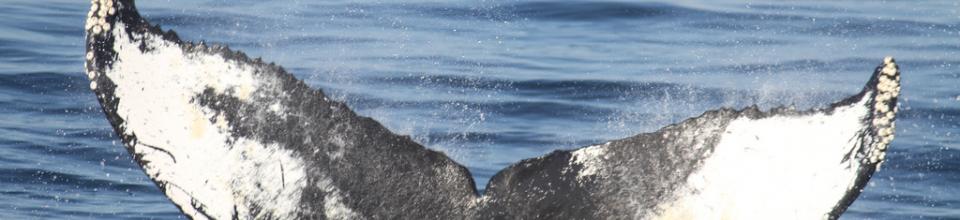
The Leviathan did revive a bit, raising her tail several stories and opening one eye to search the clear skies for the mysterious source of this cooling downpour. The massed shouts of onlookers resounded.
The public huzzahs made it clear to the authorities that nourishment should be the next step.
In two days the 18-wheelers pulled up alongside the Leviathan. One by one workmen started inserting giant hoses into the beast's mouth. And what was the magic food? Corn product. The largest, most majestic, perhaps oldest creature on the planet emerged from unknown depths in the ocean, whose meaning we have yet to unravel--and mankind served it grits.
If it didn't want to destroy humans before, it certainly had less compunction about doing so now.
After the 18th 18-wheeler had deposited its load, everyone watched and waited for any sign of revival.
Two nights later everyone was awoken by foghorn blasts from an armada. They rushed outside, everyone's flashlight beams parrying smoke. The smog carried an overpowering stench, like hell's own dump. Helicopter searchlights illuminated the subtle twist in Leviathan's lower part.
She was pushing out the remainder of a stadium-filling fart through an orifice the circumference of a South American cave. Jets and spumes of gray-brown smoke defiled the sea air, obscuring stars and the moon.
It went on until dawn. The longest, biggest fart on record--and not by a male of any species. The authorities debated whether to do anything about it but ultimately decided that, like everything else, this gas, too, would pass.
By noon the next day, it did. And then the Leviathan shat. There is no need to go into terrible detail, though it did involve much terror. At first people thought she was giving birth, the labor involved in excretion being so great.
The corn product was hardly digested. It had served as roughage, cleaning out matter that had been lodged in the intestines of the sea beast for decades. The excrement, piled high as grain hills, was so toxic as to send dozens of people to emergency rooms.
The authorities had to quarantine the area as a biohazard while dump trucks carried the waste to examination sites, where samples would be studied.
From that time onward, the incident was known as the Shitstorm, which revitalized the expression with a real-life image.
"Shitstorm just got real," people started saying.
The authorities received various requests, ranging from feeding the Leviathan another type of food to never feeding her anything again.
The next day, one could gauge the size of certain clouds by their shadows gliding on the Leviathan. The sky gives no sense of scale. Clouds seem immeasurable, unless a chance plane passes through them. But some of the gray-green shadows on the beast were not very large. The beast, if positioned in the sky, could loom over some clouds.
Gray roiling clouds blasted in from the west. A sudden wild thunderstorm chased people in all directions toward shelter. In one minute a completely different season seemed to have replaced the current one.
The cataclysm passed quickly, however, and the sun and blue sky returned with absurd speed, like a rolled-down backdrop in amateur theater. The Leviathan weathered the swift changes like an ancient outcropping.
The storm felled a tree with a triple trunk, its network of roots exposed to sun and air. Mingled with mud, the roots recalled complex innards, a confusion of capillaries and arteries.
The basement of life looks less picturesque than leaves and limbs. A large root still clinging to the ground resembled the bone joint of a dinosaur. A ruffled hawk with green identifying tags on its legs lay on the sidewalk at the foot of a 19-story office building, against which it had been tempest-tossed.
A baby hawk stood at the curb, its varicolored feathers attracting the notice of passersby. A park ranger made sure that people gave it a wide berth. "Let's keep clear, folks. Its mother will reject it if she smells humans on it."
What of the Leviathan's mother? Would she rise from the abyss to rescue or reject her young, stained by humans?
A collective shout went up from the West Bend, a local bar and restaurant. A couple of blocks farther, a united gasp emerged from the Depths, another bar and restaurant. On the overhead monitors were images of the Leviathan at night, with klieg lights trained along her length. A strange sight, since it was only 1:30 in the afternoon.
Another Leviathan had washed up. It was a live shot from China. It showed a different beach. The line underneath gave the name of the Chinese town. Police tape and sawhorses kept the crowd back.
This creature, according to the authorities, measured slightly longer but was not quite as wide around the middle as the Leviathan. It, too, was female. She had a greenish marmoreal streak along her flank. The Chinese dubbed her "Oceanic Monstrosity."
Similarly, the Chinese authorities found it hard to determine whether she was flagging or hibernating or biding her time.
The next morning, a Leviathan beached in Honduras, more or less like the previous two. In the afternoon, another one washed up in Australia. And so it went, all over the world for a week.
Governments couldn't really call it an invasion, since the creatures, although immense, remained docile. Militants insisted the Leviathans were preparing for an invasion and so campaigned to have them destroyed before they could attack.
The first Leviathan's vestigial side fins protruded more. Over 24 hours, they separated from the creature's main flank. The crowds moved back as the great gray fins started to spread.
In the distant sky, objects were headed toward a vortex in the sky. A massive shell was descending through the sun-pinked clouds. It seemed part of a much larger architecture still hidden from view.
The focus of the crowd and the authorities shifted from the Leviathan to the heavenly spectacle. It was all happening with the speed of a destructive natural phenomenon. A rough rumbling like a low-magnitude earthquake accompanied the event.
Everything was out of proportion, and perspectives were off. A conch the size of a moon shouldn't be coming out of the sky. The flying objects seemed closer to, but simultaneously distant from, the whorled structure they were ascending toward.
News was spreading among the people below. Heads turned in sequential conference. Some kind of new understanding. There was a correction being made in what they perceived.
The objects were too big to be aircraft. Each one could have been an entire squadron. They were also not rigid like airplanes.
They were monstrous creatures, Leviathan's siblings, taken wing. The biggest marine creatures had come to land...to change into the largest flying creatures in natural history.
What everyone had assumed were Leviathan's vestigial fins were actually her wings unfolding. These past months on the beach had been a cocoon stage.
The Leviathan's wings gave one final heave to separate from the flank and extend with a loud whoosh to their full span, sending onlookers sprawling. The vast sweep recalled the indifference of a landslide or tornado. Pure blithe power.
The Leviathan bellowed a prehistoric cry never before heard by modern man. It was unbearably loud, full of the pain and sadness of survival over millennia. But as she started to lift off the beach, the tone changed to something approaching primitive joy. Seawater from the Leviathan's underside rained down.
She glided above the tide and rose over the ocean, following her siblings into the shell-like mothership. By an instinct that eons had left intact, she slowed and maneuvered into the valley of a whorl and descended into a deep plum shade.
A few static flashes, and the mothership rose through the atmosphere past the point of visibility.
In time, the landscape went back to normal. It was debatable whether the Leviathans' appearance and departure had any permanent consequence.
Except now everyone walked in the shadow of a mountain range of doubt the Leviathans had left behind.